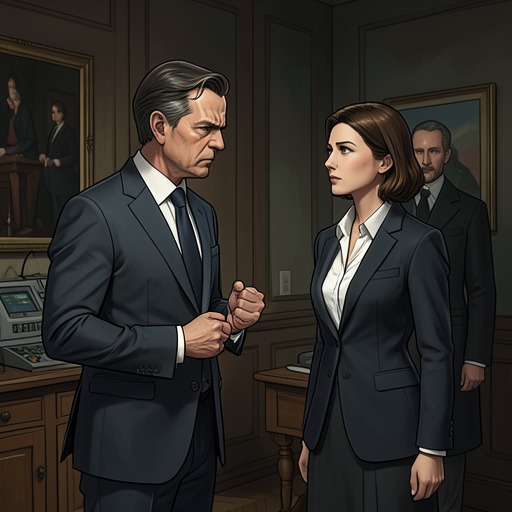
Paul and Sophie Test Their Sensing Ability with the “Find the Bauxite” Game
The Portable DoorPaul Carpenter and Sophie Pettingell turn an unpromising office assignment into a test of their unusual perceptual abilities: in a paper-and-pencil game built around locating bauxite, Sophie repeatedly identifies Paul’s marked squares, while Paul feels a distinct prickling shock when she chooses one. The results suggest that both can sense something beyond ordinary visual information, though the game cannot establish whether any marked location truly contains bauxite.
An Unexplained Assignment
Julie gives Paul two large green pocket files of aerial photographs and asks him to circle in green any areas that might contain bauxite. The instruction comes with no useful explanation of the mineral itself: Paul admits that he does not know what bauxite is, and Julie says she does not know either. She nonetheless leaves him with the photographs and the expectation that he will do a thorough job.
Sophie is with Paul when Julie departs. The assignment offers them little to do beyond examining indistinct images, and the prospect of staring at the prints for hours is not immediately productive. With Julie liable to return, they also need to look occupied. That practical pressure gives the encounter its deliberately makeshift character: an exercise in sensing develops not in a laboratory or formal test, but at a desk, among office files and work materials.
Paul’s First Sensation
Left alone with the photographs, Paul studies a couple of prints until the effort gives him a headache. He is close to abandoning the task and telling Julie that he has found no bauxite when a prickling sensation appears in the finger resting on a photograph. He compares it to the burning itch of skin scalded earlier, and the feeling stops as soon as he lifts his hand.
Paul initially suspects a reaction to the chemicals used to develop the picture. But the sensation returns in a more selective pattern: touching the faint smear left by his fingertip brings it back, while touching other parts of the same photograph does not. Removing his finger stops it again. He tries other pictures and finds no comparable response. The repeatable relation between one precise spot and the tingling makes coincidence harder to accept, even as Paul remains unsure what the sensation means.
Remembering a television documentary about people using hazel twigs to locate things, he considers whether the experience resembles dowsing or scrying. He does not take that as proof that he has found bauxite. The sensation might indicate water, a buried electricity cable, or something as unremarkable as a discarded sardine can. That distinction matters: Paul has encountered a bodily signal, but neither its cause nor its practical meaning is yet established. He circles the fingerprint smear in green, choosing it as a tentative target rather than claiming certainty about what lies there.
Making a Game of the Search
Paul proposes a game instead of continuing to inspect the photographs in silence. Sophie objects that Battleships would turn the activity into a game about warfare, which she considers barbaric and wrong; Hangman also seems a poor alternative. Paul recasts the search as Find the Bauxite: they will imagine themselves as relief agencies trying to locate valuable mineral deposits before multinational mining companies exploit them in an ecologically disastrous way.
He finds tracing paper in the desk drawer, draws matching grids with a ruler, and places a grid over each photograph. They use pencils to mark their selections and call out coordinates, borrowing the structure of Battleships while replacing its imagined ships with mineral deposits. Sophie hesitates, then agrees. The arrangement has a second practical use: if Julie or someone else enters, the pair will appear to be working rather than playing.
Sophie takes the first turn. As she calls a square, Paul traces down the page with his finger and feels the prickling sensation again when he reaches the square he had marked. Her first choice is correct. On the next turn he again touches her nominated square and feels the same mild electric-shock-like response; she has found another of his locations. Paul misses when he has to guess hers, while Sophie continues to identify his marked squares. Across the remaining turns, she guesses every one of his squares without a miss, and he fails to guess any of hers. Each correct choice coincides with the little shock running up his fingernail from the photograph.
Repeated Results and Their Limits
Sophie suspects Paul may be letting her win out of chivalry and asks to see his grid. The marked squares confirm that he has not arranged the result in her favor. She enjoys winning and immediately wants another game. They play again, then again, and after four games the pattern remains the same: Sophie finds Paul’s squares, while Paul finds none of hers. The repetition turns an odd incident into a shared problem that neither can dismiss as a single lucky guess.
Paul tells Sophie about the sensation. She has initially seemed unconvinced, but then reveals that choosing squares also feels like knowing rather than calculating. Sometimes she does not even look at the grid: a number seems to come into her head, and she repeats it. Her accuracy is therefore not simply a response to Paul’s physical reaction; she describes an inward prompt of her own. Asked whether she can use this ability to win at lotteries or horse races, she says she has never won at such things and cannot bend spoons. The limits she names keep the discovery specific rather than turning it into a claim of general supernatural power.
Neither can say whether their game has identified real bauxite deposits. Sophie does not answer when Paul asks if there might actually be bauxite beneath the selected squares. Instead, she hands him the green marker and suggests they might as well circle the locations, since the firm is paying them. Paul uses the marker on the photographs and tracing-paper grid. By the time he finishes, it is one o’clock. The test has not verified the geology, but it has changed the meaning of the assignment: what began as uninformed office work now supplies evidence that both of them may possess a form of sensing they did not know how to explain.